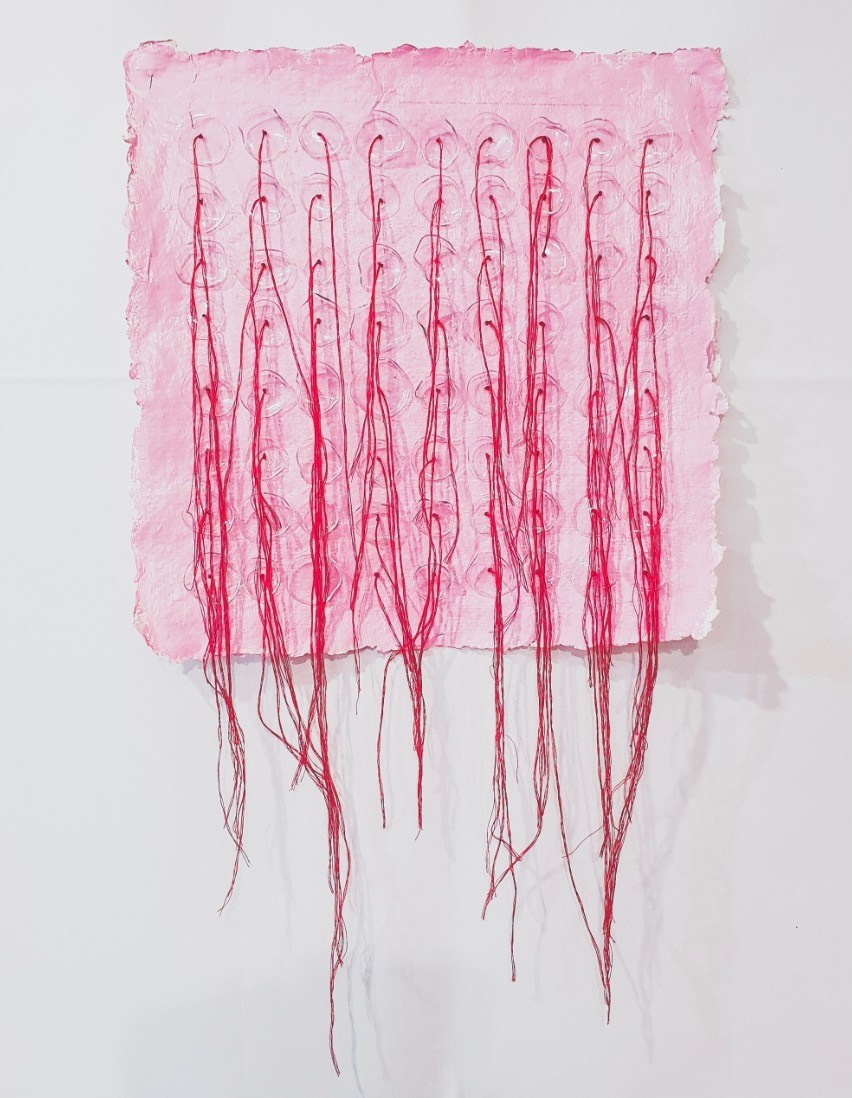
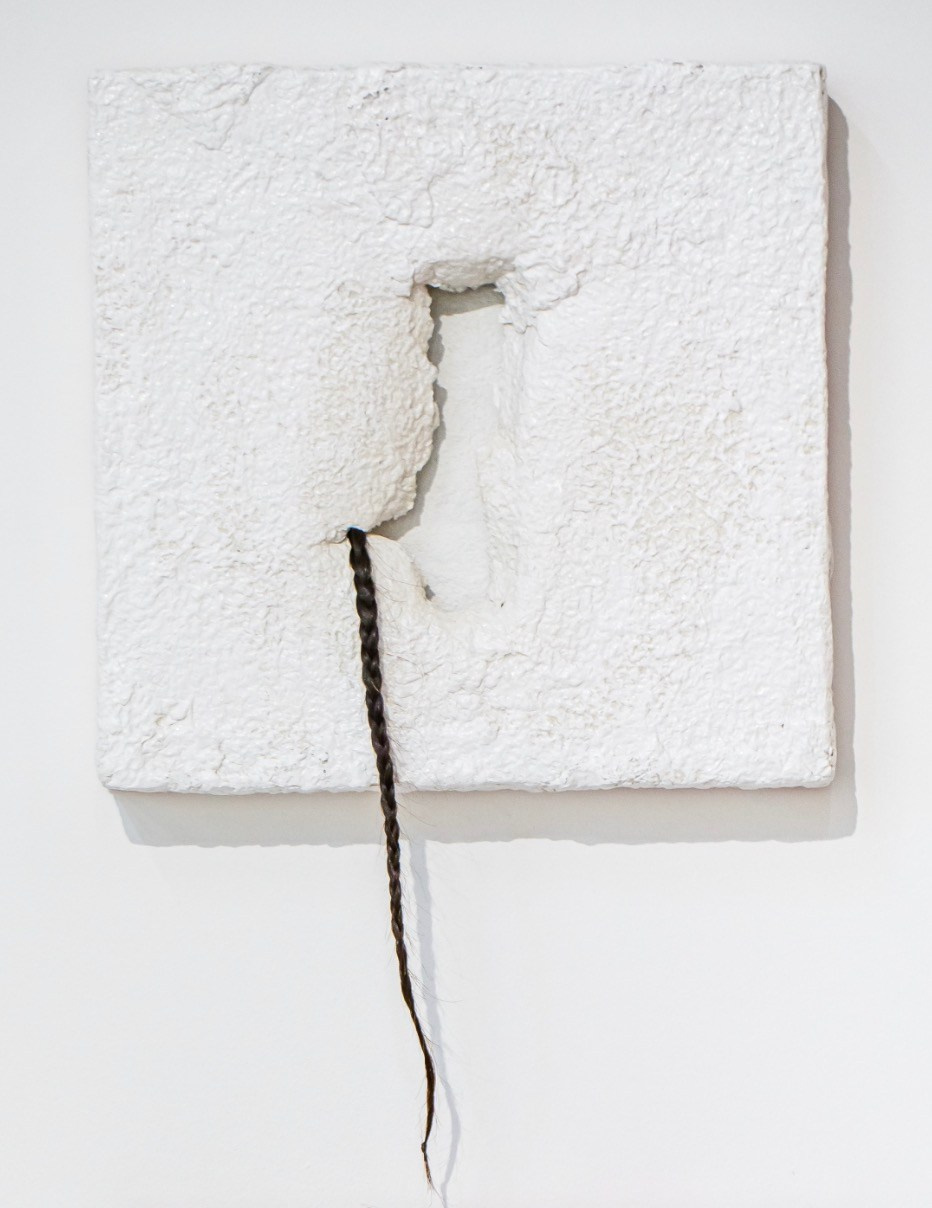
Yen Sur is a contemporary artist from Yakutia who works with recycled materials, primarily cash register receipts. Since 2019 she has been developing her own technique for transforming receipts into paper and plastic mass, which then become the basis for sculpture, graphic works and object-based art. In the interview, the artist emphasized that her choice of receipts is linked not only to ecological concerns, but also to their function as registers of everyday life. A receipt records an action, a time and a place, turning it into a carrier of micro-history. The main themes of her practice include feminism, motherhood, memory, corporeality, vulnerability and inner states. In her works with textiles, threads, hair and embroidery (for example, Mad Rain, On This Day), the artist explores emotional and bodily processes, translating them into visual structures of threads, ruptures and plastic lines. She regards these objects as attempts to materialize experiences that usually remain internal.
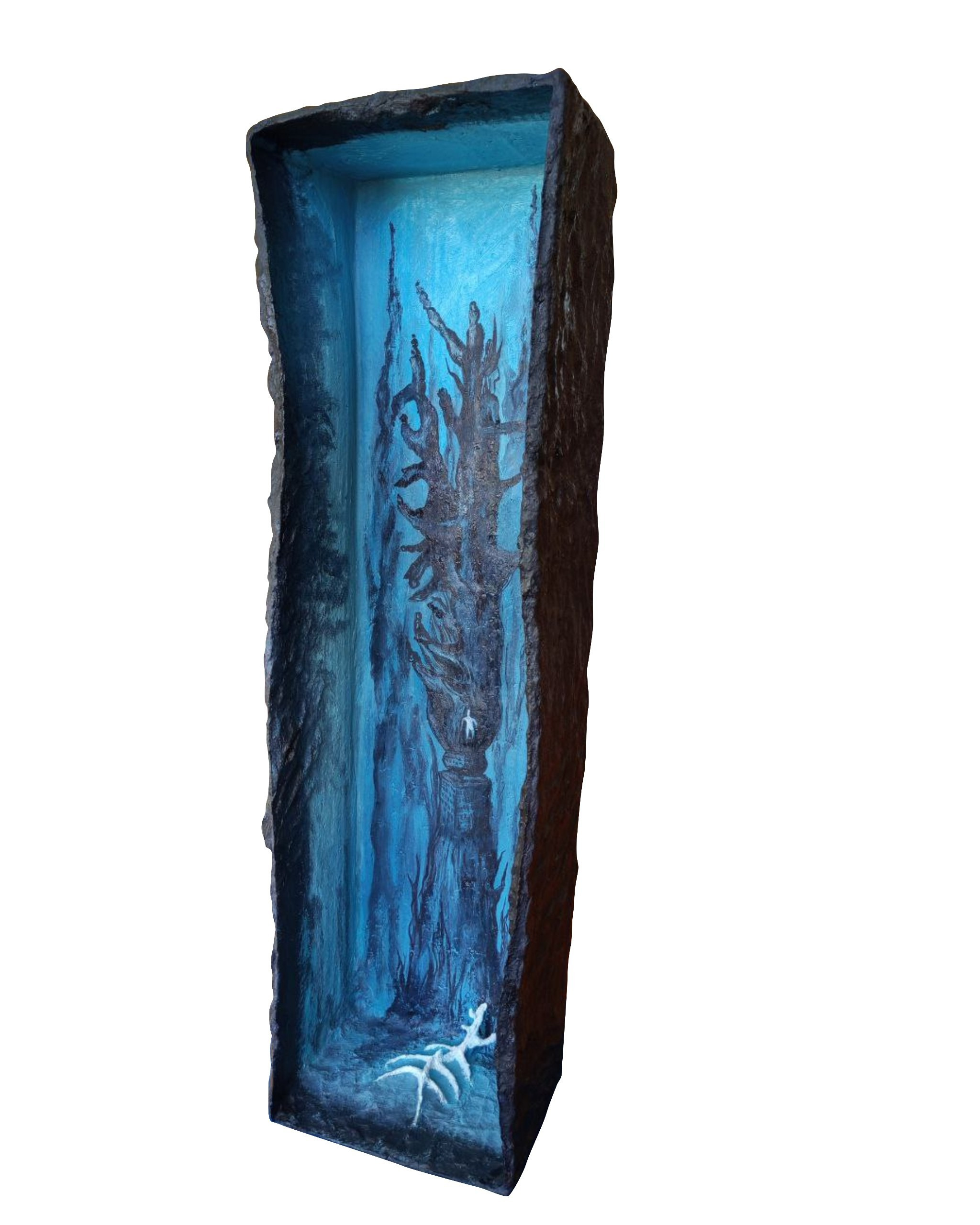
The series Tya (Forest) by Yen Sur constitutes an exploration of three states of human existence, ancestral memory, inner searching and bodily resilience. In the interview conducted as part of this research, the artist stresses that natural forms in her works function as conceptual constructs rather than depictions of nature. Through these forms, she seeks to trace the dynamics of Kut-Sür, the triadic soul in Sakha tradition, viewing it as the foundation for the formation and preservation of human integrity.
The first work is structured as an elongated niche, which invites interpretation not as an image but as a structural model of storage, a kind of container in which cultural content is concentrated. The form resembles a vessel or casket, shifting the object into the category of a place of preservation, where knowledge and ancestral memory receive material embodiment.
In Sakha tradition, cultural and spiritual knowledge belongs to the sphere of Iye kut, the ancestral and cultural soul of a person. This is the space of Iye kut, where knowledge, language, ancestral memory and the internal strength that shapes Yakut identity are held. At the bottom of the box lies a white bone of a nonexistent creature, resembling a root. It touches the earth and embodies Buor kut, the material, bodily dimension, that which returns to the soil.
Rising vertically is Aal Luuk Mas, the Yakut World Tree. In Sakha cosmology, it connects the three realms: the Upper world of the Ayy, the Middle world of humans, and the Lower world. This tree holds the human being in unity with the cosmos. Across many cultures, this verticality bears a similar meaning: the axis connecting earth and sky, the living and their ancestors. The inclusion of the World Tree within an enclosed space strengthens the idea of knowledge as a value that requires protection and careful preservation. The vertical composition thus establishes a three-tier model of the soul, in which the material (Buor kut), cultural (Iye kut) and spiritual-dynamic (Salgyn kut) form a unified structure. The emegët figure inside the niche represents the mechanism of cultural continuity.
Originally, the emegët was a protective amulet carved from wood or birch bark, and shamans carried brass emegët pieces attached to their garments. It was believed to contain power, and as long as that power remained, the emegët protected its owner. When the power left, the amulet became an ordinary object. It was cherished, carried, and used as a mediator between humans and spirits. Importantly, the power of the emegët was not constant; it could disappear. This possibility of loss makes the image particularly expressive: if the power departs, the emegët becomes merely a thing, just as culture can lose its content if not preserved.
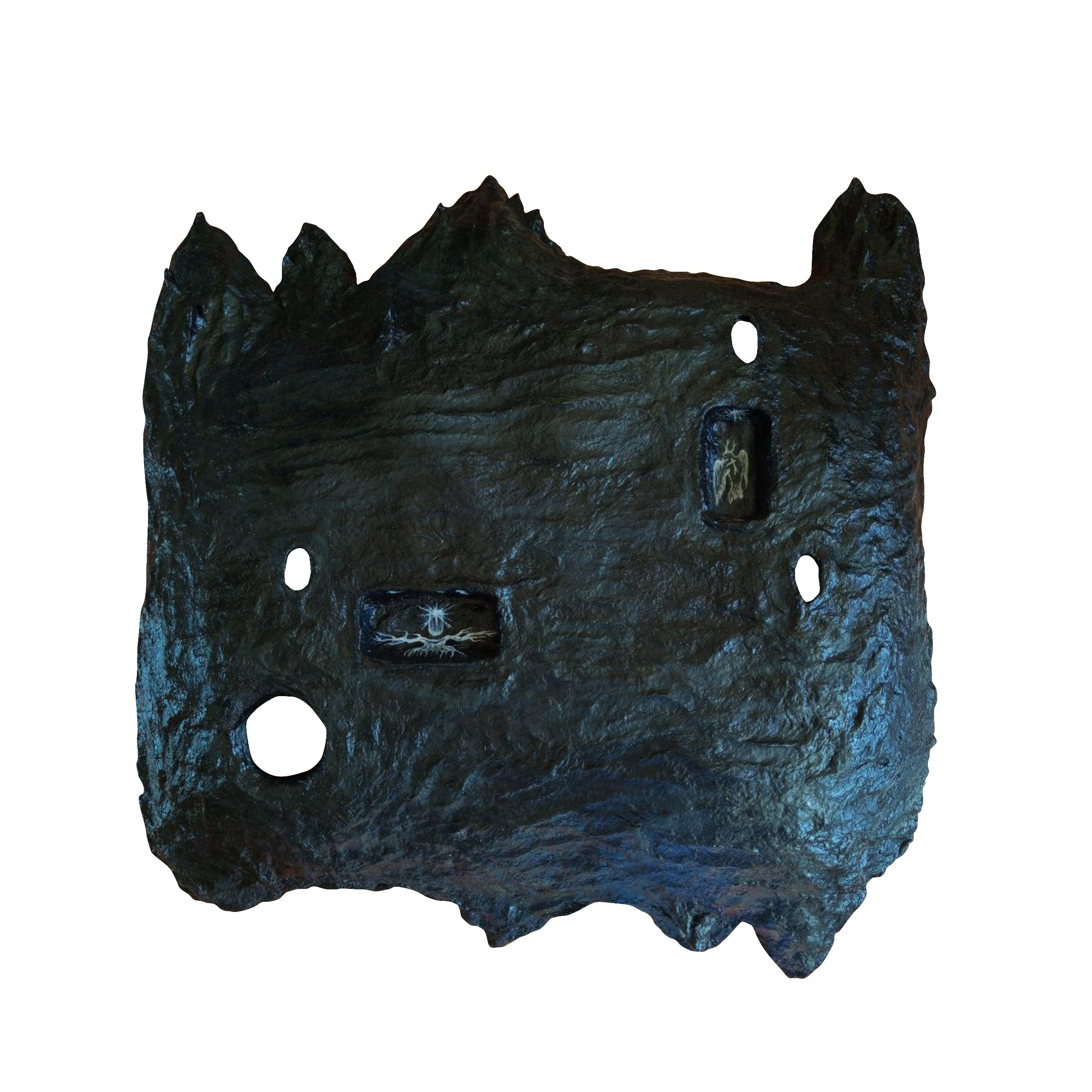
The second work presents the forest not as a landscape but as a visual incarnation of Salgyn kut. The relief resembles a map of a dense nightly thicket, where cavities, niches and openings form a structure akin to traces and pathways of movement. Such a composition accentuates the idea of Salgyn kut as creative searching. The artist directly links this image to her own experience of interacting with nature. In the interview, she notes: “I walk so far until the forest becomes dark, dense, almost impenetrable. And it is precisely there, in solitude and silence, where the external path disappears, that an internal one appears.” This statement emphasizes that the forest is seen not as a decorative element but as a space where direction is defined not by visual markers but by the state of the soul.
Here the forest is not a romanticized image of nature but a symbolic field of transition. In traditional Sakha culture, the natural landscape—particularly the forest—is interpreted as a place inhabited by spiritual forces, but not as a threatening environment. The forest is a zone of attunement between human and natural rhythms, where the correct inner state becomes the primary condition for safe passage. In this work, the forest appears as the symbolic “dwelling” of Salgyn kut, a space of restoration and inner insight.
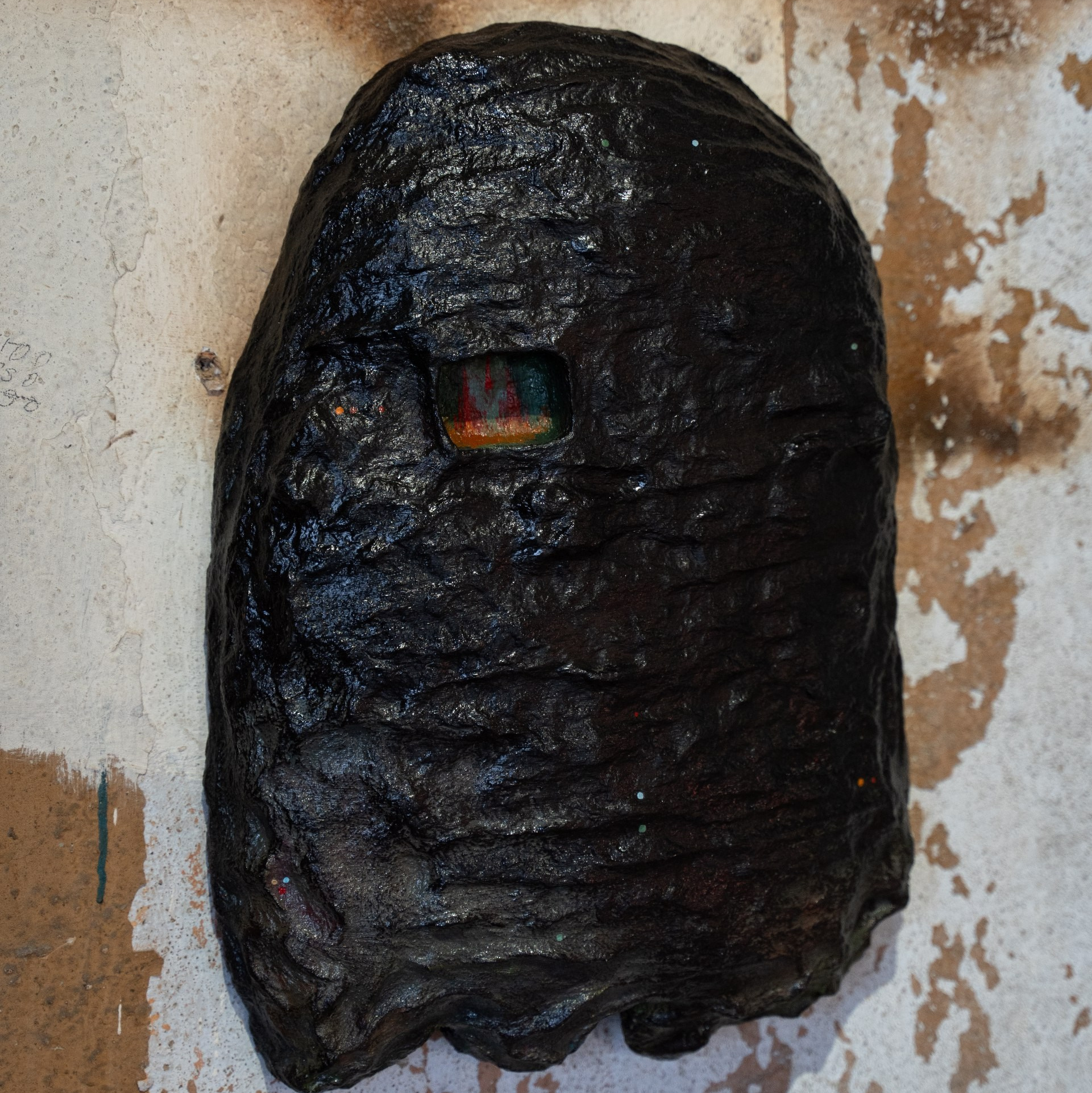
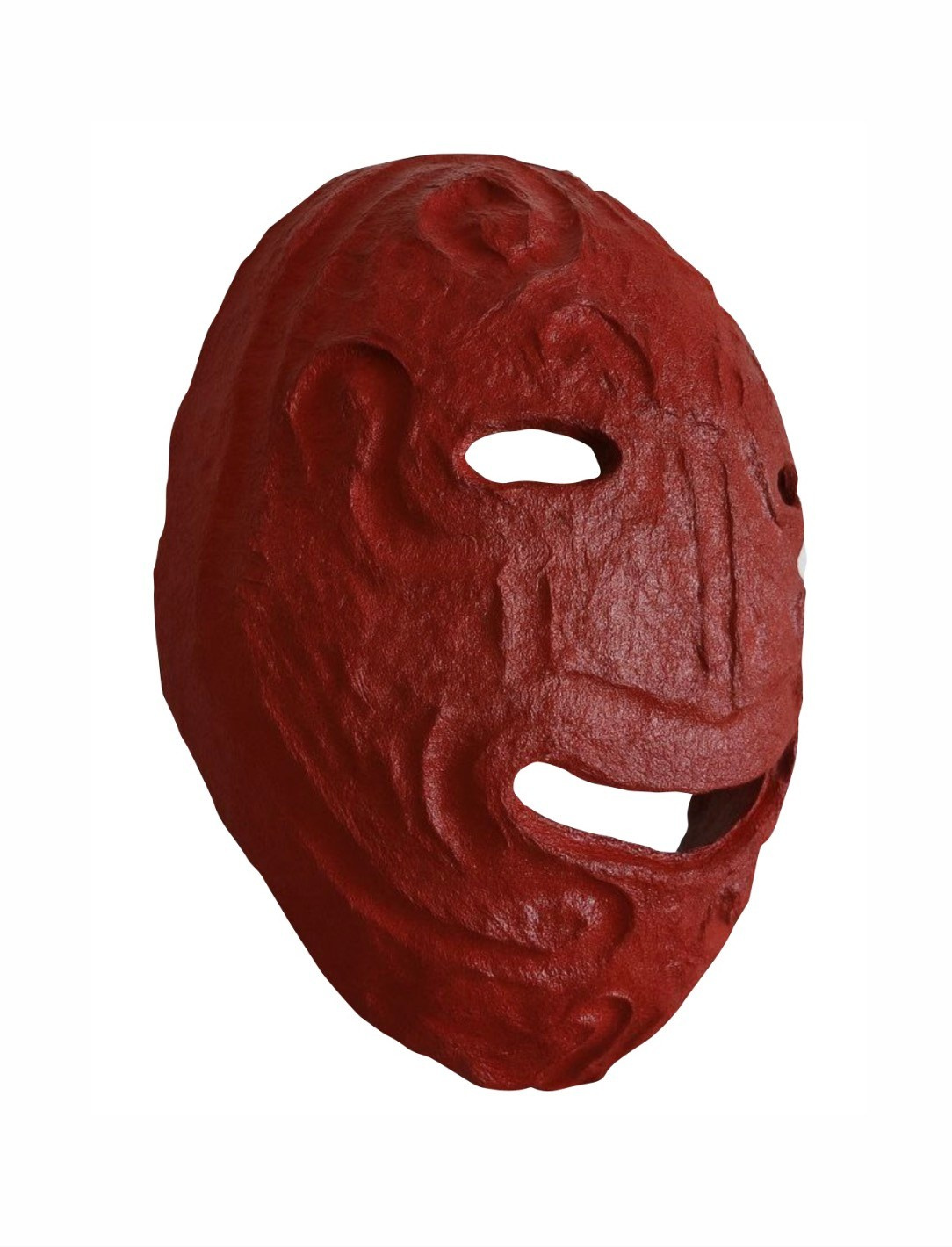
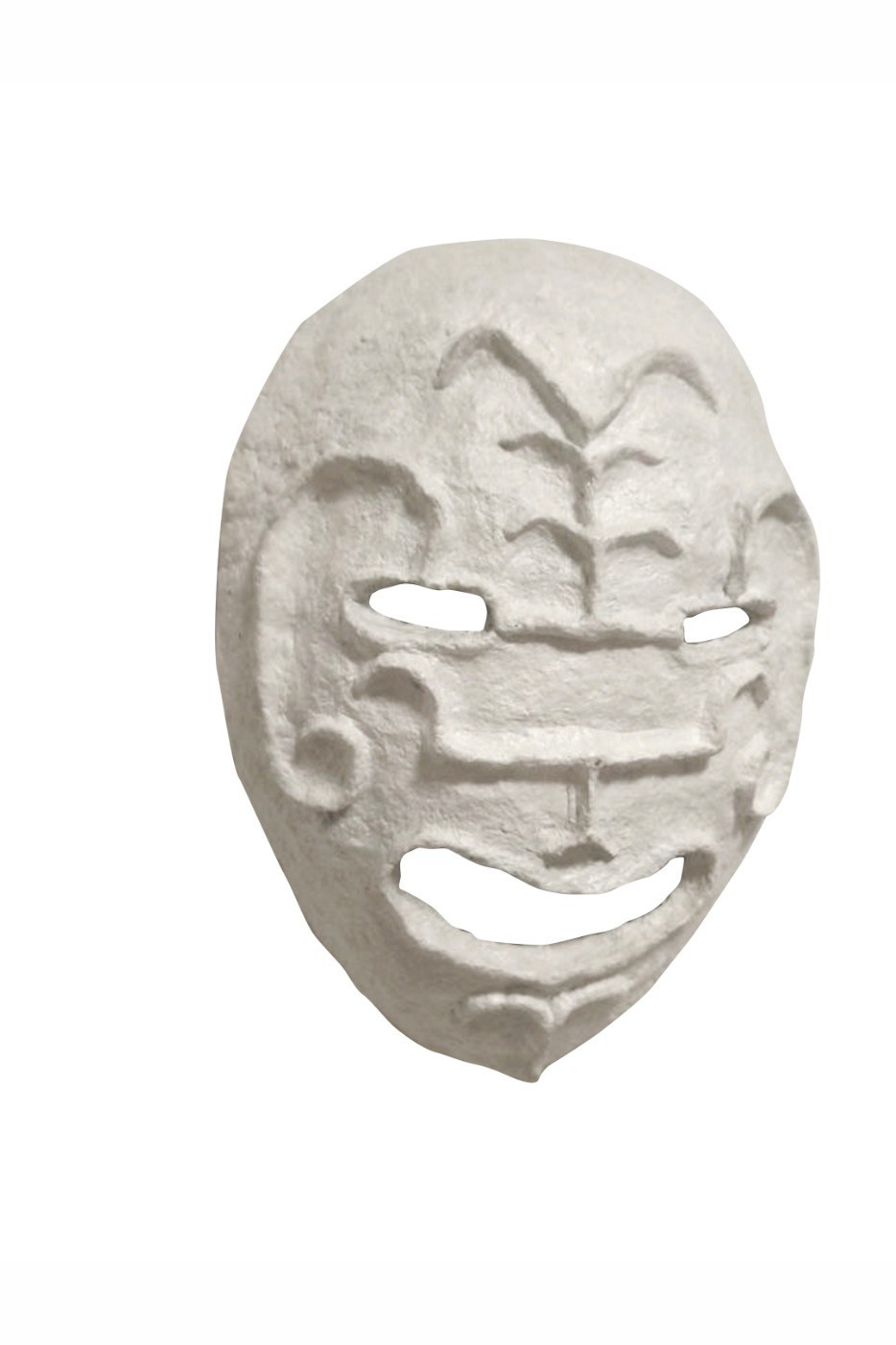
The third work is a stone mask with a small glowing window. This piece speaks of the moment when the artist’s body “became stone.” Buor kut, the earthly soul, manifests here in its most literal form: the body begins to seem solid, eternal, unmoving. Stone is a material that outlives time. Its form resembles a mask, and this is not accidental. The artist often creates masks, and in her practice a mask does not conceal identity but holds it. In this work, the stone mask becomes her own embodiment not of appearance but of essence. Stone does not erode. Stone holds form. Stone preserves cultural code.
The three pieces form three states of the human being, three modes of soul-movement and three manifestations of Kut-Sür. This visual cycle may be interpreted as a path from ancestral memory to inner searching and, further, to bodily resilience and the preservation of cultural code. In this series, the tree, the forest and the stone appear as three distinct visual “languages” through which the artist reflects on her own origins, memory and inner
The series is perceived as a single artistic journey. The first work presents the vertical model of the World Tree, which in Sakha cultural tradition acts as a structure for storing and transmitting knowledge. The second turns to the image of the deep, dark forest, functioning as a space of transition and inner orientation, opening a path to those who enter without fear. The third work, associated with the image of a stone mask, emphasizes the preservation of the body, memory and inner light as stable elements of human existence.
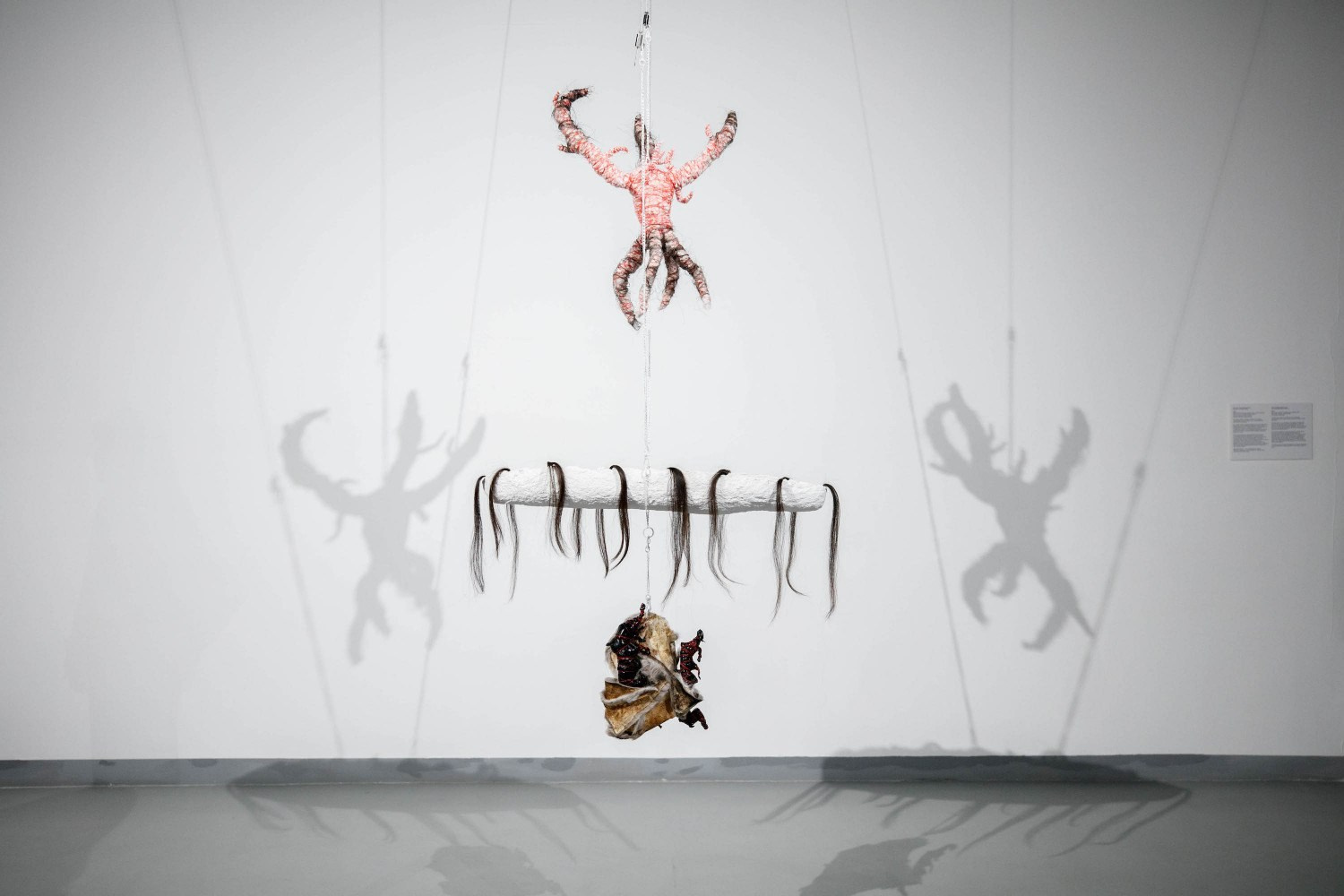
The work Generation by Yen Sur is a three-level spatial composition that addresses the themes of birth, origin and the interaction between humans and the upper worlds. The work is based on a legend described by G. V. Xenofontov about the birth of shamanic twins. According to the myth, a young woman meets a youth who turns out to be the son of the deity Ayy, Khara-Suorun. From this encounter she conceives two shaman sons, yet before they appear in human form, she gives birth to two baby ravens. The birth must take place under specific conditions: on a horse hide, next to a three-branched tree, and during the first three days the fledglings must lie in the left side of the yurt, wrapped in the same hide. Only after these conditions are fulfilled do the creatures take on human shape. This mythological narrative serves as the conceptual foundation for the spatial structure of the work, in which each element reflects a particular stage or qualitative state of birth.
In the interview, the artist emphasizes that her focus in this work is not on the figures of the shamans nor on shamanism itself, but on the woman through whom birth occurs. Notably, in the project description the artist deliberately uses the expression dyakhtar kihi — “woman-person.” In the Yakut language, the word dyakhtar (woman) is usually used without the qualifier kihi (“person”), while the term for a man is er kihi — “man-person.” The artist consciously aligns these constructions, introducing dyakhtar kihi by analogy with er kihi. This choice underscores the active subjecthood of the woman and affirms her status as an autonomous human being, not solely a biological mother or mythological figure.
Thus the artist shifts the focus from the image of the shaman twins to the very process of the emergence of life and the role of the woman as the central link. The formula dyakhtar kihi becomes not merely a linguistic gesture, but a conceptual assertion of equal human status embedded in the structure of the artist’s statement. The composition of the work is organized vertically and reflects the three levels of the triad Kut-Sür: Buor kut, Iye kut and Salgyn kut.
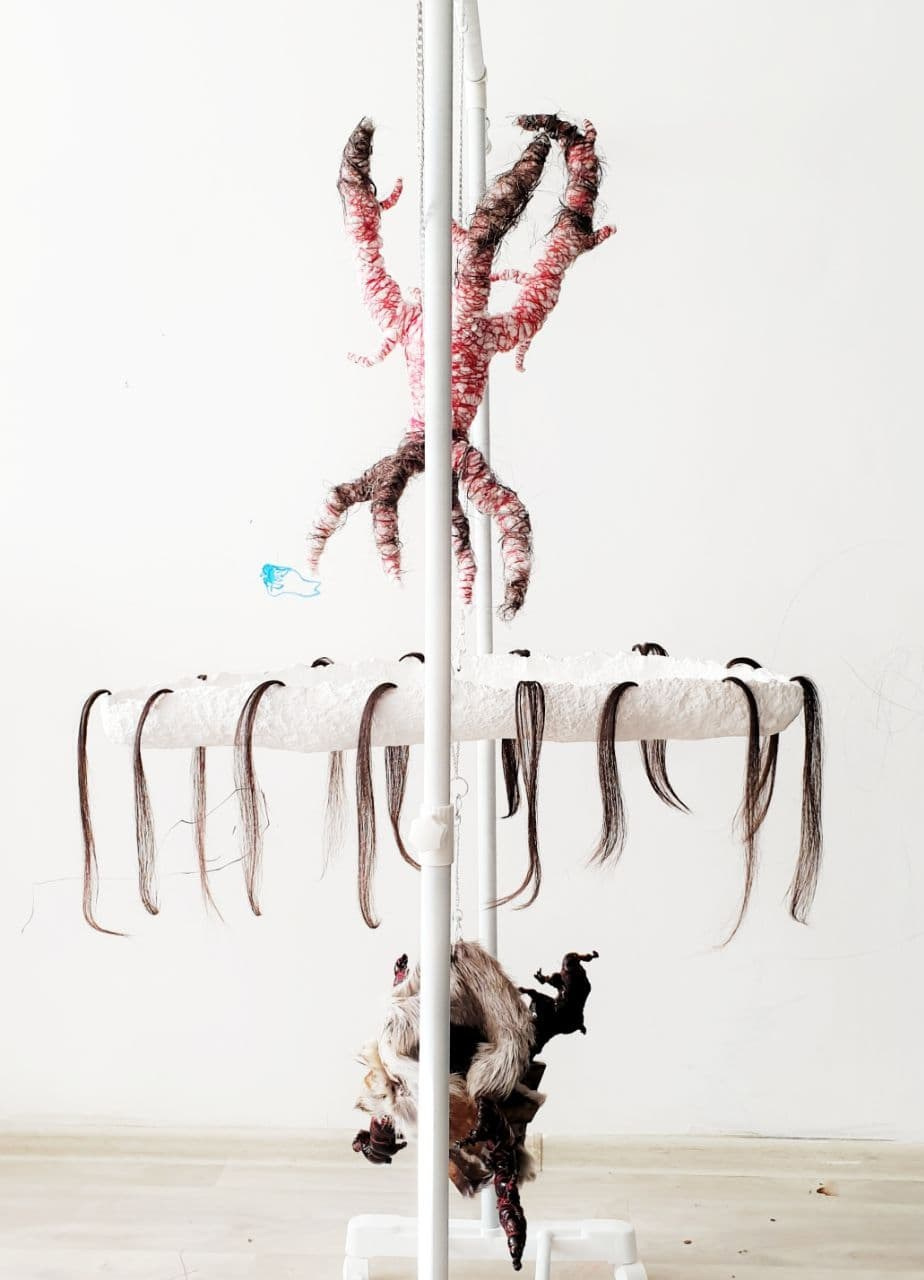
The lower element of the composition, made of wool, leather and organic fragments, represents the material, bodily level, Buor kut the dense, heavy beginning, the space where life germinates. The middle level, a white form resembling a boat or a womb, corresponds to Iye kut, the ancestral soul. It symbolizes the space of becoming, where life has not yet acquired its final shape. This level is connected to the prescriptions of the myth: the birthplace, the sacred hide and the ritual conditions for the emergence of the future shamans. The upper figure, constructed from material that creates branching forms, along with its enlarged shadows on the wall, constitutes the level of Salgyn kut, the living breath.The artist emphasizes that the shadows are not a secondary effect, but a part of the composition: they express processuality, movement, the energy of birth. The upper level connects the object with immaterial forces, setting the dynamism and orientation of the entire composition.
The work Generation is constructed as a visual model of birth, in which the three levels of Kut-Sür are presented in the form of three spatial layers. The woman as dyakhtar kihi appears as the central figure linking matter, ancestral memory and vital energy. The piece presents birth not as a biological fact but as a complex spiritual and bodily process involving the human being, the surrounding space, mythological forces and the cosmological structure of the Sakha world. Through a contemporary artistic language, Yen Sur reinterprets the traditional notion of the origin of shamans, highlighting the role of the woman as the subject who simultaneously holds the triune nature of Kut-Sür.
BIBLIOGRAPHY
Ksenofontov, G. V. Shamanism. Selected Works. Yakutsk: Creative Production House “Sever-Iyug”, 1992.
Popova, G. S. The World Tree Aal Luuk Mas in Contemporary Yakut Sakha Culture. Values and Meanings, 2019, no. 4 (62).
Popova, G. S. The Triadic Essence, Human Needs, and Theories of Cultural Genesis. Yakutsk: Institute of Languages and Cultures of the Peoples of the North-East of the Russian Federation, M. K. Ammosov North-Eastern Federal University.
Popova, G. S. Tri-Unity in the Spiritual Culture of an Ethnos. Monograph, edited by E. P. Borzova. Saint Petersburg: Asterion, 2009.

Ayar Kuo, between two worlds: the memory of a people in images

Mystic Forest
