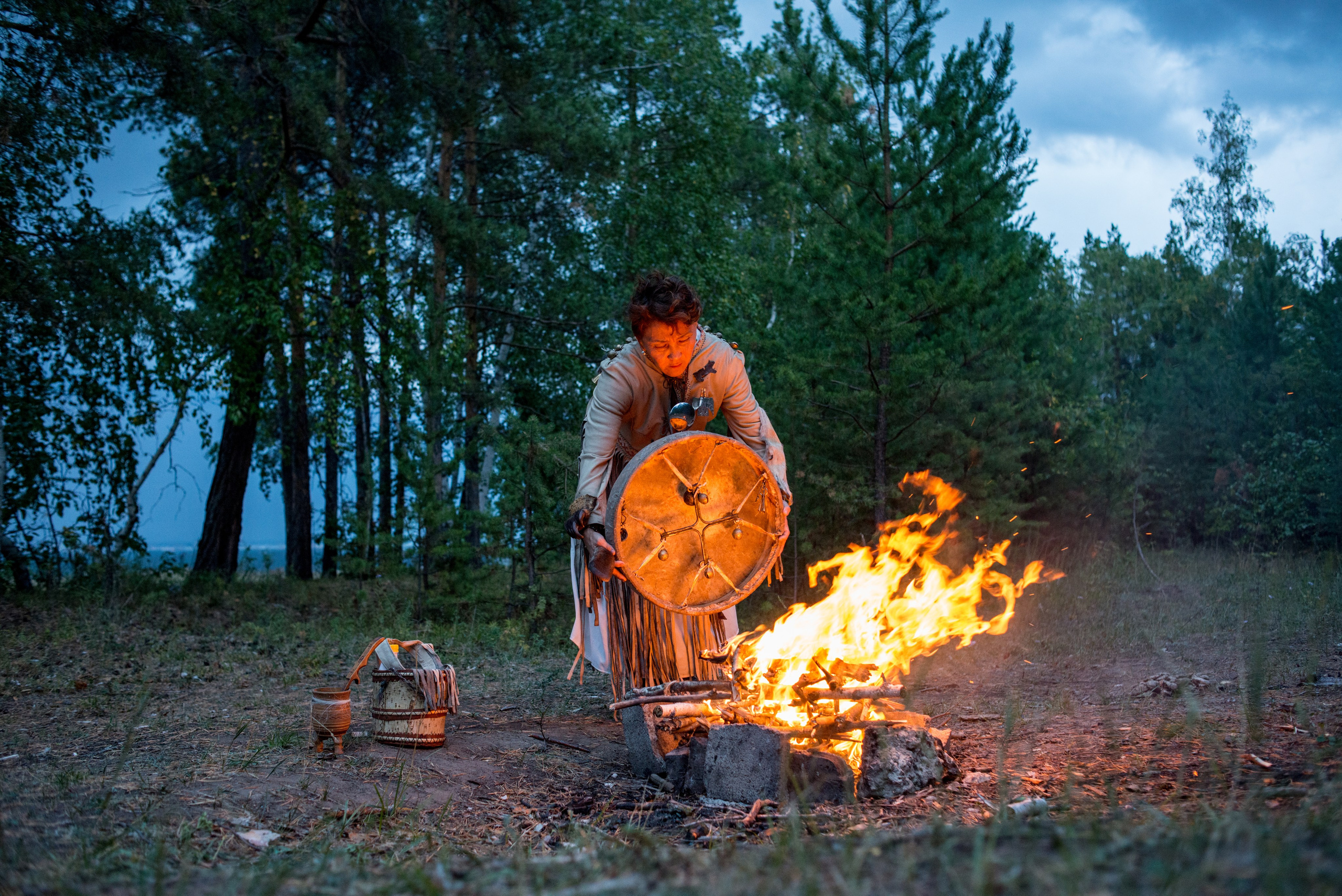
At the forest fringe as dusk draws near—where the light wavers between the sky’s blue and the fire’s gold the shaman bows her dyunyur towards the flames as one turns their face to the wind. The drum drinks in the heat, swelling with life: its hide breathes, tightens, quivers, ready to become the skin of an alternate world. The Yakuts say that every thing has an itch-tchi, even objects crafted by human hands. The dyunyur is no mere instrument: it is a hollow body where the paths are woven in. When the shaman warms it like this, she is not simply tuning its voice—she is awakening the routes that bind the earth, the sulus, or stars, and the deep places where the üör—the restless souls—prowl. The fire rises before her, bright and blazing, like a tamed beast that still bares its fangs. It is guardian, threshold, protector—no evil spirit dares cross its circle. Through Sieroszewski, we read that the Yakuts do not fear the fire: they respect it as a living entity, almost a member of the household. Here, in the silent taiga, its radiance reveals itself amid a stand of pines, embracing the shaman’s body in its warmth.
Her ritual coat, weighted with chyllyryt kykhan—metal plates—and with small bells, already seems to attune itself to the drum’s spiritual vibration. At her feet, the sacred offerings wait like discreet companions. The entire forest seems intent, a witness to the age-old rituals that still echo in its roots. In this suspended moment, the shaman is no longer only a woman: she becomes a conduit, a voice, a reverberation between worlds—one who can render audible what the wind whispers secretly to the trees. A mask of fire adorns her face and illumines the invisible circle where the spirits stand. Introverted, she completes her preparations, and the fringes of her garment connect her with all that has been, all that is, and all that will be. In the depths of Yakutia, where the nights stretch long and the stars walk slowly, this gesture—warming the drum—becomes an opening, a threshold, a breath. And in the rustling of pine needles, one can almost discern the faint footsteps of these generations that came before. The wind still sings the chants of the elders.
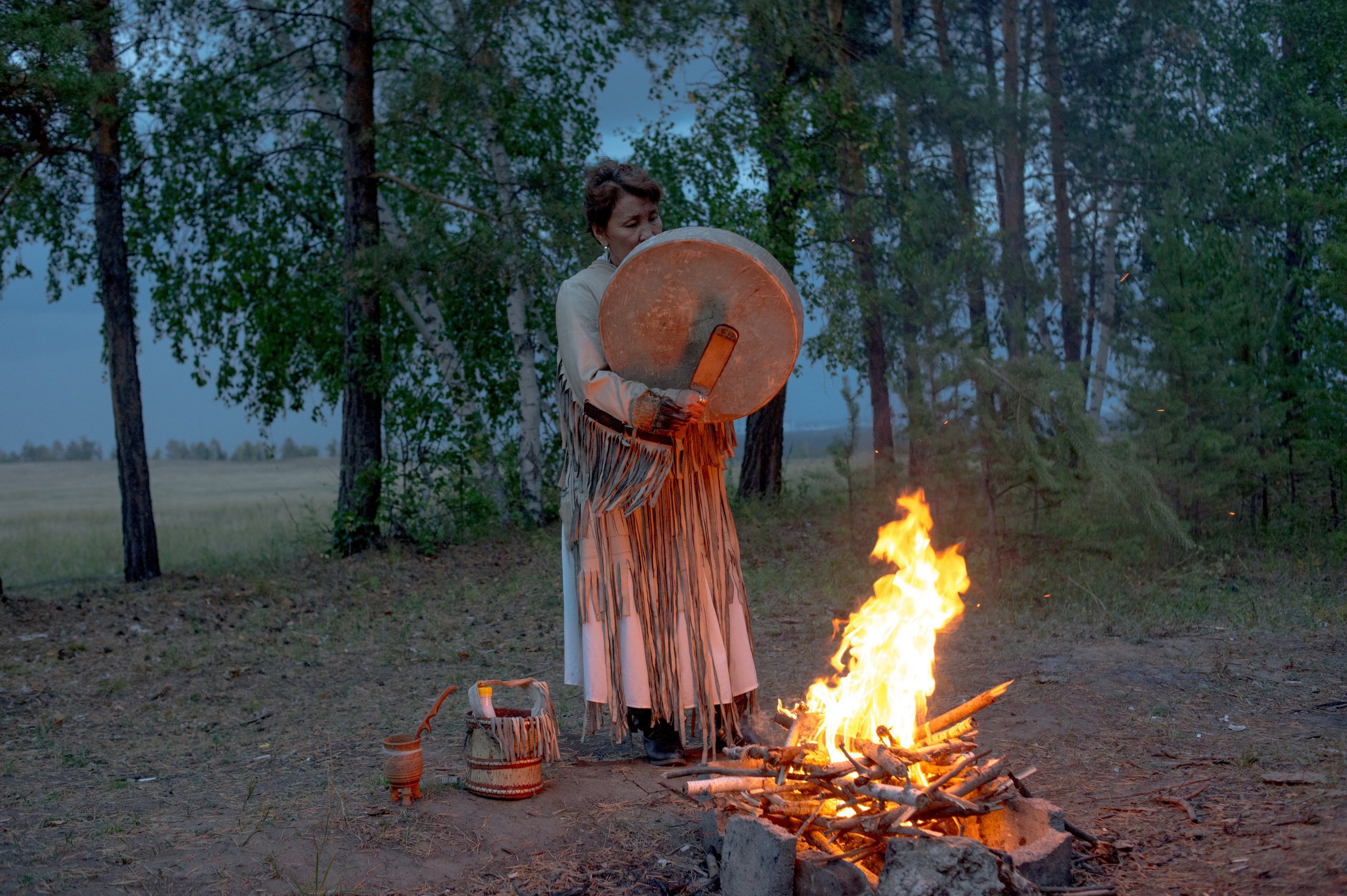
The shaman faces the fire the way one stands before an elder kin. The small cup at her side holds kumis, that milk spirit offered to the higher beings, to Aï-Toïon, and to the unseen masters of nature. In the woven vessel lies curdled milk, sacred nourishment, a white substance tied to purity, to fertility, to the dawn of the world. Nothing here is placed by chance; every element bears a meaning, a memory, a continuity. The shaman lifts the dyunyur and strikes it to the rhythm of the elements, her grounded stance drawing the fire’s attention. Her spirit is already entering another plane, the one where the masters of the place—the doïdou ichtchitè—come to listen. The fire is not only light and warmth—it is the guardian, the one that even the üör, the restless dead, do not dare to cross. A low vibration rises—round, enveloping. It is the first step toward trance. For in shamanic thought, the dyunyur is not a mere instrument: it is a cosmic horse, a breath that pierces the layers of the worlds. The kumis refreshes the benevolent spirits, while the curdled milk recalls the mildness of the origins, and at last the fire opens the passage. The shaman is the intermediary, the one who speaks for the living, the one who receives the grievances of the dead, the one who binds these two realms for a brief moment.
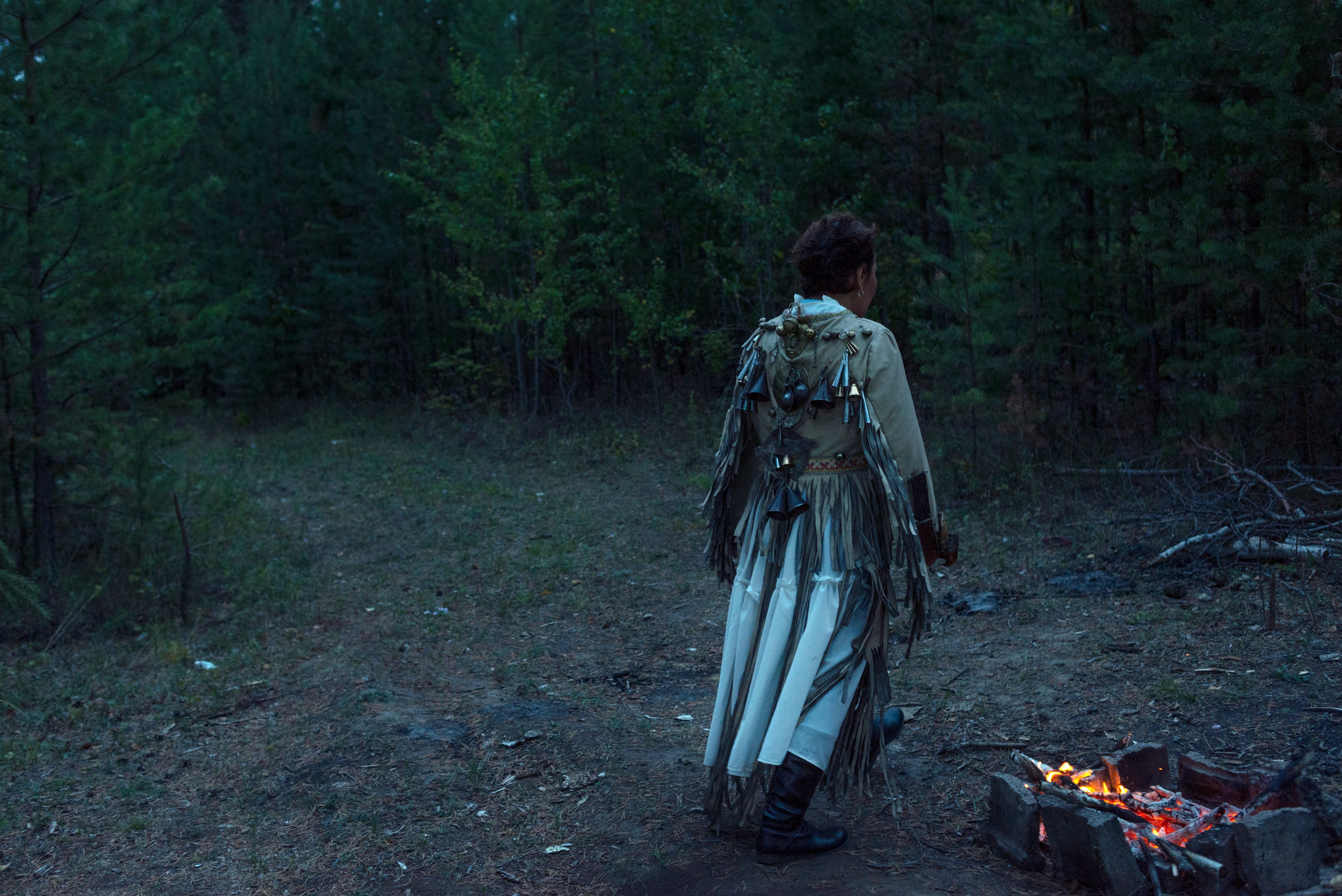
The fire has fallen silent after its feasting. In its ember bed, it returns to the earth. In the nascent darkness, the shaman walks like a living shadow, a kuylyuk, moving away from the hearth and at last revealing the back of her garment. Around her, the forest murmurs, and she answers it with the sound of her tinkling bells. Has she felt the presence of Oïuur-toïno, the bear, master of the forests—the one treated as a kinsman, flattered, respected, almost always invoked in a low voice? Has she sensed the breath of forgotten ancestors? Above her, invisible behind the timberline, breathe the sulus, the living stars. And somewhere higher still lies sis khallaan, ‘the seam of the sky, ’ the Milky Way, which weaves the worlds together like the threads of a cosmic cloak that only the shamans know how to decipher.
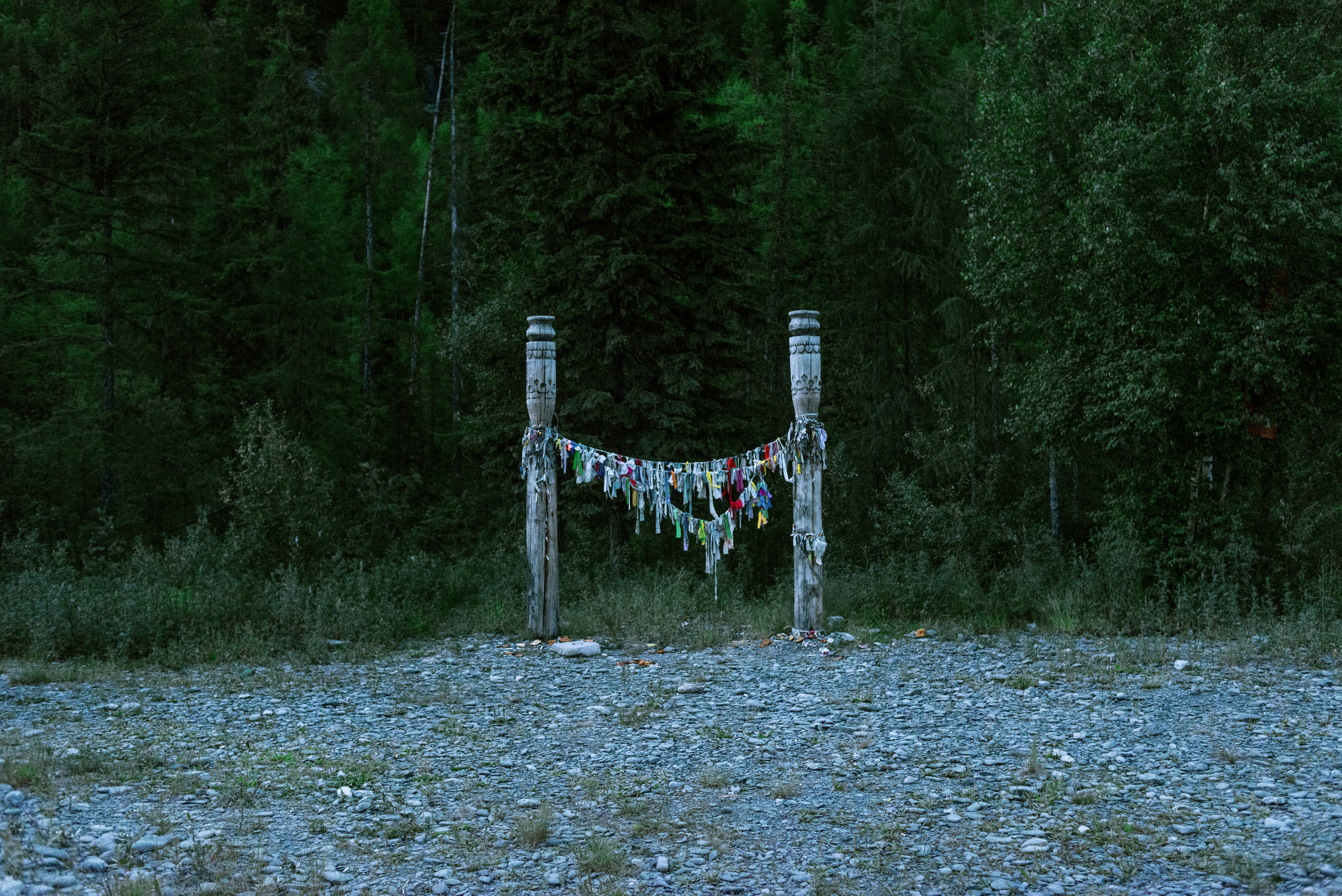
At the forest’s edge, where the pebbles spread out like an ancient riverbed, stand two carved wooden votive poles that mark the invisible presence of the natural forces—the masters of the place. Their wood bears a patina, polished by wind and seasons. Offerings—hundreds of tied ribbons—sway gently. Fragments of cloth, rags, colored fibers: all these human traces laid down to soothe, to give thanks, and to ask. Each ribbon carries an energy, a faint soul imparted by the hand that tied it. Are the spirits able to read our intentions there? It is a place where the living address the unseen, where offerings are laid. A place where respect is given, where the memory is kept of those in transit seeking protection, of families asking for healing, of herders imploring mercy for their animals, of those who venture into the green dusk of the mystic forest. These pillars stand as guarantors of our passage; they bear witness to our intentions.
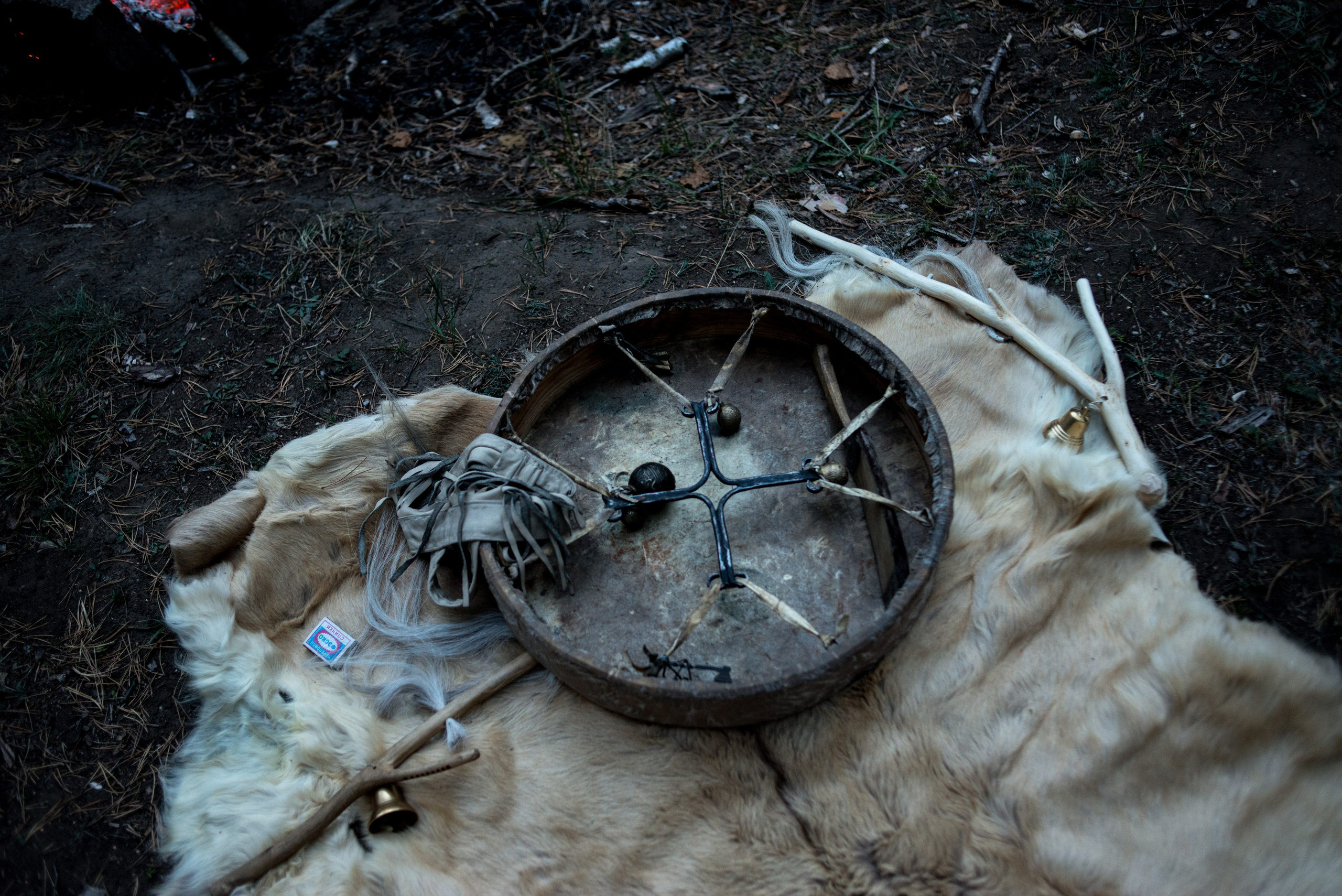
Thus the ritual comes to its end—the drum, in turn, releases the power the fire had bestowed upon it. Moisture soothes it and draws it into a deep slumber. Its inertia casts us out of the oneiric world and sends us back to the reality of the physical world. At least… until next time.
Bibliographie
Bychkova Jordan, B., & Jordan-Bychkov, T. G. Siberian Village: Land and Life in the Sakha Republic. Minneapolis: University of Minnesota Press, 2001.
Granberg, A., Soini, E., Kantanen, J. Sakha Ynaga: Cattle of the Yakuts. Helsinki: Finnish Academy of Science and Letters, 2009.
Mikhailovskii, V. M. Shamanism in Siberia and European Russia. Piscataway (NJ): Kiraz, 2012.
Okladnikov, A. P. Yakutia Before Its Incorporation into the Russian State.
Sieroszewski, W. Du chamanisme d’après les croyances des Yakoutes, pp. 204-233.
Sieroszewski, W. Du chamanisme d’après les croyances des Yakoutes, pp. 299-338.
Stelmaszyk, M. Shamanism in Siberia: Sound and Turbulence in Cursing Practices in Tuva. Londres: Routledge, 2022.
Sumner, W. G. The Yakuts. The Journal of the Anthropological Institute of Great Britain and Ireland, Londres, 1901.
Troeva, E., Isaev, A., Cherosov, M., & Karpov, N. The Far North: Plant Biodiversity and Ecology of Yakutia. Berlin: Springer, 2010.
Znamenski, A. A. Shamanism in Siberia: Russian Records of Indigenous Spirituality. New York: Springer, 2003.

“Ije. Buor. Salgyn”: An artistic model of the triad.

Ecology of the Soul: Kut-Sür in the Visual Practice of Yen Sur.
