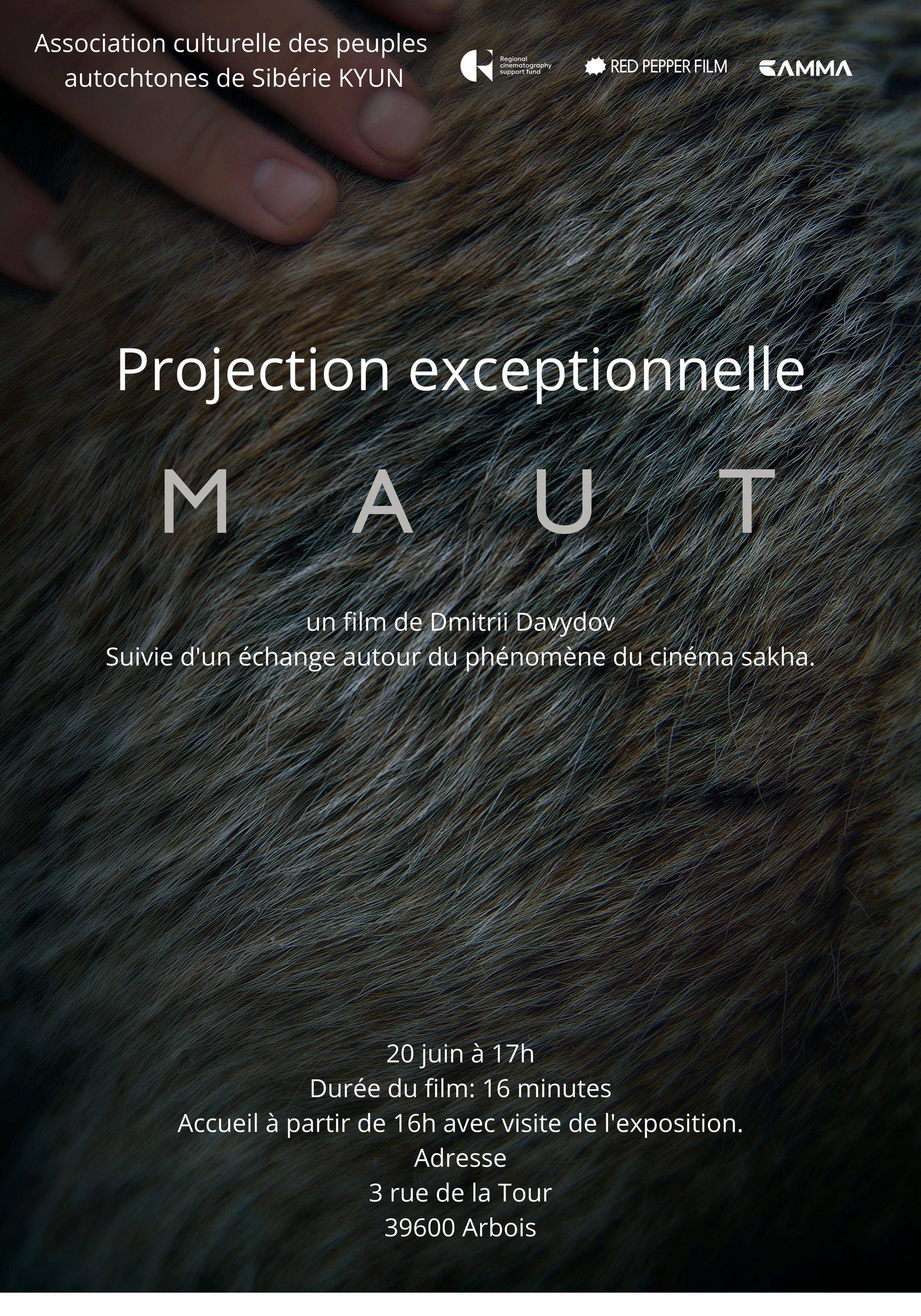
On June 20, as part of the cultural programme accompanying the summer solstice celebrations organised by the KYUN association, a special screening of the short film “MAUT” took place in Arbois. The screening offered festival guests an opportunity to discover contemporary cinema from the Republic of Sakha in the Jura.
The film was made available to the association by its director, Dmitri Davydov, specifically for this screening, before any public presentation. The guests gathered in Arbois thus became the first audience to discover this work.
The screening was followed by a discussion involving participants and representatives of Indigenous peoples. The conversation focused on the development of independent cinema in the Republic of Sakha, as well as the issues raised by the film. “MAUT” addresses the survival of reindeer herders and the nomadic peoples of the North, whose traditional ways of life and knowledge passed down through generations are increasingly threatened by rapid changes in their environment and the forces of globalisation.
Born in the village of Amga in the Republic of Sakha, Dmitri Davydov entered the world of cinema without formal film education. Before becoming a director, he spent sixteen years working in education as a teacher, psychologist and extracurricular activities organiser, before becoming head of the local school. It was through working with young people and establishing a video club with them that his interest in filmmaking first emerged.
Today, he continues to work as a filmmaker. His films include “Bonfire”, “River”, “There Is No God but Me”, “Scarecrow”, “Youth”, “Plague” and “Transparent Lands”. Since 2016, he has been a member of the Asia Pacific Screen Academy (APSA).
The screening offered guests attending the summer solstice celebrations an opportunity to discover the work of a filmmaker from the Republic of Sakha and to exchange views on the realities and challenges facing the Indigenous peoples of the North.


Le deuxième Festival du Cinéma Yakoute à Paris

« Défilé des nomades de Sibérie »

