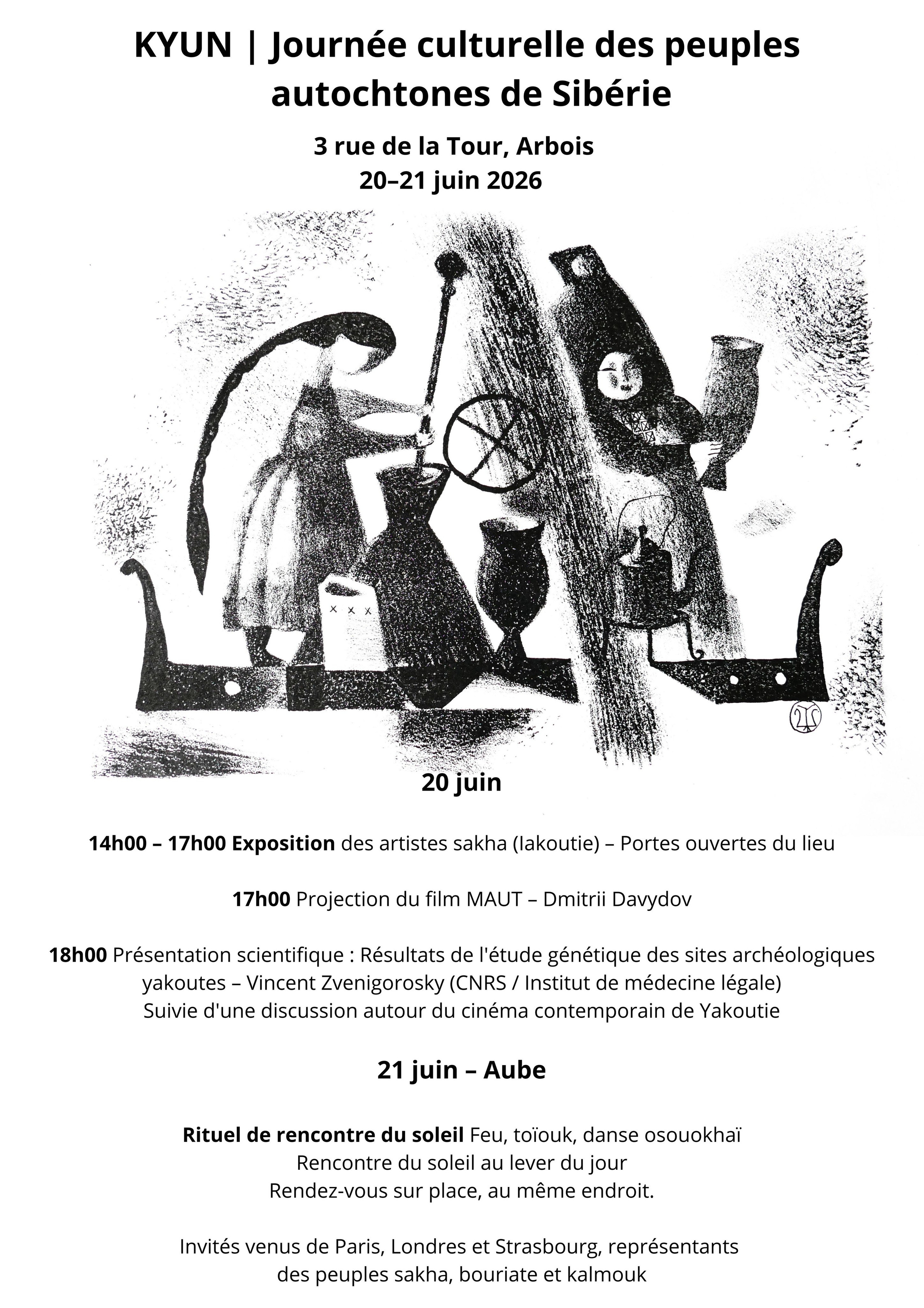
From June 21 to 23, during the summer solstice, the French town of Arbois in the Jura region became a meeting place for representatives of various cultures and peoples. The celebration of Yhyakh, the traditional holiday welcoming summer, nature’s renewal, and the beginning of a new life cycle, took place here. The three-day meeting was organized by the KYUN Cultural Association of Indigenous Peoples of Siberia. The event brought together representatives from the Republic of Sakha (Yakutia), Buryatia, Kalmykia, and Dagestan, as well as guests from Paris, Lyon, Strasbourg, London, Lausanne, and Zurich.
The main goal of the gathering was to create an open space for cultural exchange, getting to know one another, and strengthening ties between people united by an interest in the traditions, history, and cultural heritage of their peoples. The program combined artistic, scientific, and cinematographic projects, allowing participants to explore various ways of understanding and preserving cultural memory.
The event featured the opening of an exhibition by Sakha artists, as well as a photography exhibition by photojournalist and researcher Ayar Kuo. The exhibitions presented a contemporary artistic and documentary interpretation of cultural identity and heritage. A special highlight was the presentation of scientific research on genetic data from Yakut archaeological sites, delivered by Vincent Zvenigorosky (CNRS / Institute of Legal Medicine). The film program included a screening of the film “MAUT” directed by Dmitry Davydov. Following the screening, a discussion took place regarding contemporary Sakha cinema, its artistic language, and its place in the cultural space.
The culmination of the celebration was the sun-greeting ritual at dawn on June 21. Among the vineyards of Arbois, participants gathered to connect with the ancient tradition linking humans to nature, the earth, and the cyclical rhythm of life. A ritual fire was lit, traditional algys blessings were spoken, and improvised toyuk singing was performed. The morning concluded with a joint ohuokhai circle dance, uniting participants in a single rhythm and movement. Outside of its historical homeland, Yhyakh became an opportunity to experience the traditions of the Sakha people and a way to share them with representatives of other cultures.
An integral part of the meeting was the joint preparation of national dishes. Around a shared table, participants shared family recipes, introduced each other to the culinary traditions of their peoples, sang, and conversed. It was in such simple moments shared meals, conversations, music, and the exchange of personal stories that a special atmosphere of mutual trust and closeness was born.
The meeting in Arbois became an example of how cultural traditions can cross geographical boundaries, find new participants, and create a basis for dialogue between peoples. For the KYUN association, this initiative became part of a broader activity aimed at popularizing, preserving, and developing the cultural heritage of the indigenous peoples of Siberia, as well as building connections between communities living in different countries.
Preserving culture means turning to the past while passing on knowledge, sharing experiences, and creating new forms of interaction in which traditions continue to live and find meaning in the modern world.


Le deuxième Festival du Cinéma Yakoute à Paris

« Défilé des nomades de Sibérie »


